flower
IMAGINE A GREAT NATIONAL PARK
Aerial images provided by Bob Hurt. Click on each image to enlarge. Book contains 37 aerial photo's!
summer1fall1winter1summer2fall2winter2

strip


 E-MAIL bryan@driftlessrivers.org
A DAZZLING NEW BOOK—"THE BECOMING OF THE DRIFTLESS RIVERS NATIONAL PARK,” IS A PASSIONATE LOOK AT A RELATIVELY UNKNOWN AREA OF WISCONSIN

book
Wisconsin author Bryan J. Stanley enlightens readers and encourages them to help create a new national park on the western edge of Wisconsin.

Bryan J. Stanley has cast a spell over his readers in his recently published book, “The Becoming of the Driftless Rivers National Park.” He spent over six years exhaustively researching and writing the book that is as beautiful as it is interesting.
            As a lover of nature, Bryan J. Stanley is particularly passionate about the Driftless Area in Wisconsin’s Crawford County. The great outdoors has been a cornerstone of his life for as long as he can remember.
            “I wrote the book because I’ve had a sense of wonder about national parks ever since I explored Yellowstone National Park in 1978 and I believe this land has similar potential,” he says. Stanley, who was trained as a soil scientist, grew up in the Driftless Area, and eventually earned a bachelor’s degree in Natural Resources and Soil Science from the University of Wisconsin-Stevens Point.
            In the early stages of writing the book, he took the pulse of national park enthusiasts. “I put an ad in a local newspaper and asked people if they would respond to a survey about national parks. The results showed the majority of respondents had a similar passion for national parks that I have.” In one question, they were asked what they use national parks for. Stanley says, “Respondents said they enjoyed sightseeing, hiking, viewing wildlife and camping, in that order.”
            While Crawford County is punctuated with magnificent natural beauty—the Mississippi and Wisconsin Rivers run along its western and southern border respectively, along with hills, cliffs and bluffs, glens, gulleys, rivers and ravines, Stanley also recognizes that the area’s character may be best understood by the people who left behind their invisible footprints here long ago.
            “The cultural aspects of the Driftless Area are very interesting,” he notes. “The significance of the people who lived here or whose lives intersected here is historically important. It was fascinating to delve into their stories.”          
            Stanley is adept at taking the reader back in time. Readers learn about the Paleo-Indians who lived in the area 12,000 years ago. He also covers various American Indian tribes, like the Lakota, Winnebago, Menomonee who lived here as well as the Woodland cultures and Mound Builders who built over 500 mounds in Crawford County many of which are effigy mounds.
            “The history of the people of this area is so important to the story of the creation of this national park.” Stanley says that Chapter Five, titled ‘The People’ is the longest chapter in the book at 17,000 words. That’s a lot of words, and I tend not to be a wordy person.”
            There are many famous names in Stanley’s book, and they are all tied to the Driftless Area. “Zachary Taylor stayed here when he was commander of Fort Crawford when it was an important frontier Army post in the 1830s. Jefferson Davis, president of the ignominious Confederacy, served here as an Army officer, as well as many other legendary people like the French explores Marquette and Joliet.”
            Art, history and culture come together in Stanley’s book. Early in his writing, he knew that he wanted to give his book artistic guideposts. He contacted the publisher of Jean Auel’s best-selling book, “The Clan of the Cave Bear,” for help in locating the artist, Hiroko, who painted the cover art for Auel’s book.
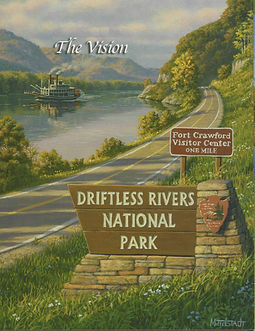
            Eventually, Stanley decided upon Frank Mittelstadt, a Wisconsin artist well known for his wildlife and landscape art. Mittelstadt is the name behind the book’s extraordinary paintings that help the reader visually explore the Driftless Area. Stanley also commissioned aerial photographer Robert J. Hurt who captured a collection of rare sky-view photos of Crawford County. Award-winning book design by Joe Mogensen of JM Creative. Surface photography by De Maio Photography.
            Stanley’s book is far more than a ‘coffee table’ presentation, which it well could be because of the exceedingly large number of full-page color photos of the Driftless Area in all of its seasons. In addition to being an enlightening and entertaining book, Stanley’s narrative guides the reader into understanding why it is important to preserve and protect the area for future generations. He carefully tackles the questions of why this national park, and why now?
            He also has a plan in mind. His hope is to enlist readers in helping him create awareness of the area, and in so doing, establish the area as a national park. He estimates that if Congress enacts legislation creating the national park in the area, it will cost about $900 million to acquire the 375,000 acres. That is less than one half the cost it takes to build a new space shuttle of  $2.4 billion. “But when you put the cost in perspective, the park will generate an estimated $193 million each year in direct spending and create an additional $124 million in indirect spending when those dollars are re-circulated in the economy.
            Stanley is passionate about his endeavor and has pledged the profits of his book toward the creation of this new park. “As it stands right now, it would be fourth in size of national parks east of the Mississippi. Not only would it provide economic opportunities, but it would be an excellent source of recreational potential,” he adds.
            He is realistic that there may be a long road ahead and hopes his book will be the jumping off point that is needed to involve more people in his passion, the wellspring of interest will undoubtedly take time.
            In relation to this project, since the mid-1990s, a new park proposal has been going on in Maine to create the 3.2 million acre Maine Woods National Park. Stanley sees the efforts of this other group of people on the East coast as favorable to his own efforts. “It shows that people want national parks and they are willing to go through a considerable number of hoops to make them happen.”
            In his own early research six years ago, surveying park enthusiasts, he discovered this telling fact: “The people surveyed said they were willing to travel hundreds of miles and more for a national park experience.”
            Stanley recognizes that creating a national park is a big task,” I see the book as a beginning to making that happen. In the interim, I believe people of all ages will get something out of this book,” he adds. “The Driftless Area is a fantastic, beautiful area waiting to be discovered.”


>>TEN FAST FACTS

The Becoming of The Driftless Rivers National Park

Bryan J. Stanley’s beautiful book is a must for outdoor enthusiasts. You are invited to explore a region in western Wisconsin, alongside the mighty Mississippi and Wisconsin Rivers called the Driftless Area. If the name “Driftless Area” conjures up images of wild streams, lush valleys, and unspoiled forests, you are right.

Take a few moments and test your knowledge of the area. See the area as Stanley does, through a wide-angle lens collecting history and stories from the Ice Age to modern times.

Did you know?

1. How the “Driftless Area” got its name? Glacial drift means the soil, rubble, sand, and rocks that were left randomly on the landscape by the movements of continental glaciers. The Driftless Area was never covered by the glaciers that covered much of the Midwest, hence no glacial drift—hence the Driftless Area.

2. How in pre-historic times Wisconsin was as mountainous as the present day Rocky Mountains.

3. Why the majority of the great pre-historic rock art sites in the Midwest are located in the Driftless Area of Wisconsin.

4. That the Sedimentary rocks of the Driftless Area are from the Paleozoic Era and up to 545 million years old!

5. That Yellowstone National Park was the first national park created by Congress with President Grant’s signature on March 1st, 1872

6. That Father Jacques Marquette and Louis Joliet, were the first Europeans to visit the upper Mississippi Valley when they reached the Mississippi River by way of the Wisconsin River on June 17th, 1673.

7. How the little river town of Victory, Wisconsin got its name. The legendary town was named after the Battle of Bad Axe, in Vernon County where the great Chief Blackhawk surrendered to American forces in 1832.

8. How a nearly complete mastodon skeleton was discovered in 1897 a few miles east of Crawford County near the town of Boaz.

9. That the four counties of Crawford, Richland, Vernon and Grant, have over 900 miles of trout streams.

10. That the Driftless Rivers National Park will generate $316.46 million dollars in direct/indirect spending annually and create up to 5000 jobs.


All profits from the sale of The Becoming of the Driftless Rivers National Park will go to the establishment of the Park or to purchase and preserve other natural areas within the Driftless Area.

30 DAY MONEY BACK GUARANTEE! If you're not completely satisfied, return the book for a full refund.

The book features 37 wonderful aerial spreads!
 

Marketing Specialist  
  ©2007. Bryan J. Stanley. All rights reserved.